"The future of interpreting"? Not if it's quietly written without interpreters in it.
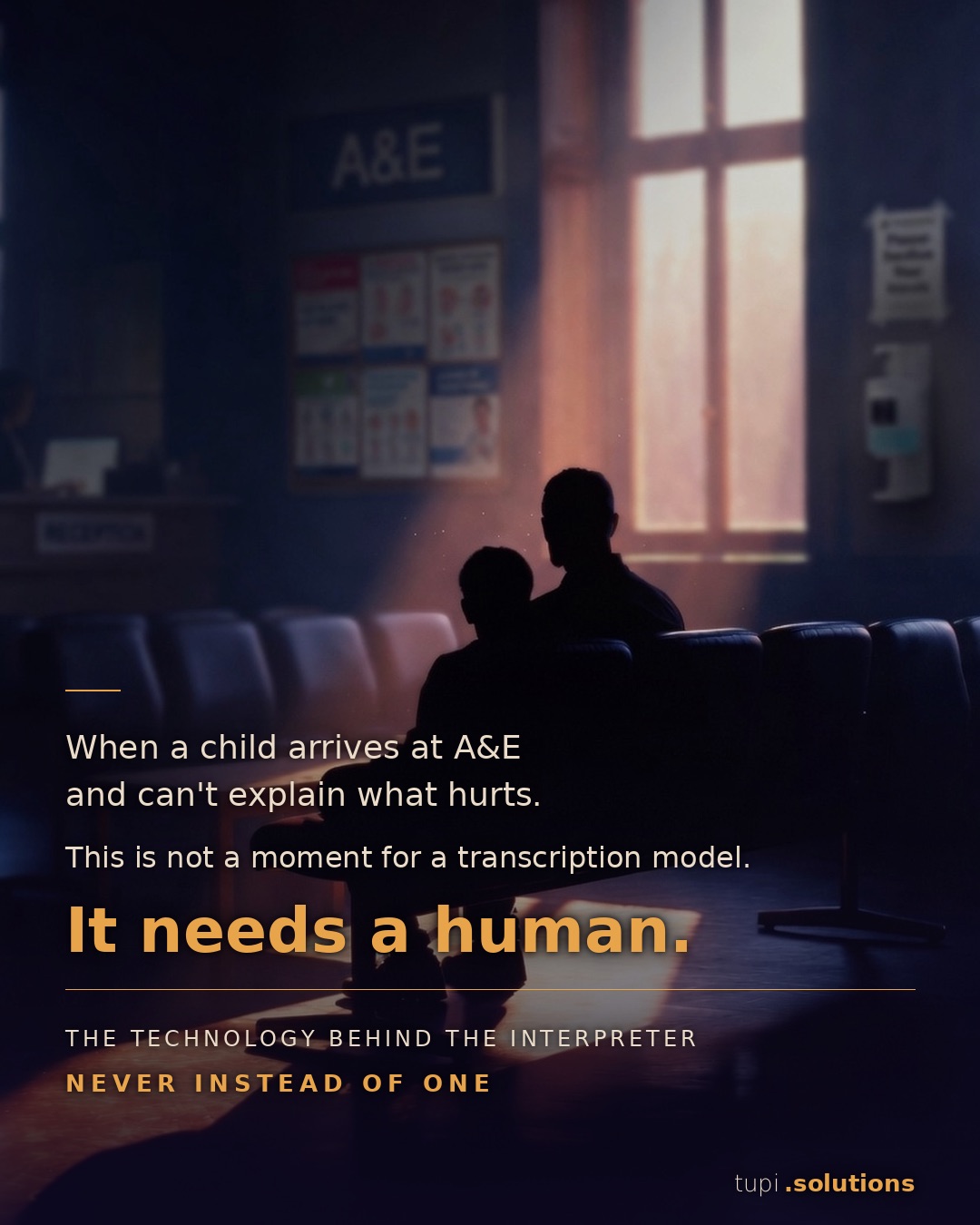
Picture the call an AI is now sold to handle: someone phoning to book an appointment. Routine. Low-risk. The "easy" kind, we're told, that machines can take so humans are freed for the work that matters.
Except the person on the line has waited four months for that appointment. Or they're calling to schedule a cancer screening. Or, halfway through confirming a date, they mention, almost in passing. That they've stopped taking their medication. None of that announces itself in advance. It surfaces mid-sentence, in the call everyone agreed was safe.
There is no such thing as a mundane call. That single fact is where the fashionable case for AI interpreting quietly falls apart. And it's where this piece begins.
Read the marketing, not just the reassurances
There's a particular pitch doing the rounds in our industry. It invites you to "experience the future of interpreting." It promises customers they'll "save around 20%." It tells buyers that booking a human interpreter can be "as easy as requesting an Uber." And it lines up an "AI Interpreter," "AI live translation" and a consumer app right alongside the human professionals, marketed straight into healthcare, legal, education and government.
To be fair, the same providers often publish careful, responsible-use guidance admitting their AI can't manage a complex conversation, can't infer cultural context, can't flag confusion, and that "mistakes, omissions and hallucinations remain possible."
So which is it? Because those two messages pull in opposite directions. And the people most likely to be caught in the middle are the ones holding the budget.
Think about who actually signs these contracts. In a hospital trust, a council, a courts service or a corporate, the buyer is usually a procurement or category manager, not an interpreter, not a clinician, not anyone who has ever sat in a room watching a skilled interpreter rescue a conversation. They are handed two claims at once: "this is the future" and "this saves 20%" on one slide, and a dense, carefully-worded limitations disclaimer somewhere in the appendix. Guess which one drives the decision.
To a non-specialist buyer comparing line items on a spreadsheet, an "AI interpreter" and a human interpreter look like two prices for the same thing. They are not. The disclaimer that says the tool "can't infer cultural context" or that "hallucinations remain possible" reads like boilerplate small print, the kind every software contract carries, rather than what it actually is: a warning that this product can fail silently in exactly the high-stakes moments the buyer is procuring it for. The marketing is designed to be understood; the limitations are designed to be acknowledged and forgotten.
That is the confusion we worry about most. Not interpreters being fooled. They know the difference. It's the well-intentioned procurement lead, under pressure to cut cost, who genuinely believes they're buying like-for-like at a 20% discount, and only discovers the gap when a mistranslation has already done its damage in a courtroom or a consulting room. At Tupi Solutions, we think the economics tell you which message wins. And a buyer who doesn't live in this industry deserves to have that spelled out, not buried.
When the headline number is "save 20%," the product is substitution
Here is our honest read. You do not market a tool as "the future," price it on cost savings, and brand it like a ride-hailing app if your real ambition is to sit quietly behind a human professional. You do that when the human is the cost line you intend to shrink.
"Augmentation" is the language. But a 20%-savings, on-demand, app-first pitch is the language of replacement economics, where AI is the default and the human becomes the expensive exception you escalate to only when something breaks. That is not technology supporting interpreters. That is technology slowly designed to need fewer of them.
And the profession can't afford to misread the difference. NRPSI registrations have already fallen by roughly a third in a decade. The Institute of Translation and Interpreting warns that the real risk is a decline in the perceived value of linguistic skill. ACIS and NUPIT/Unite are fighting for minimum rates and statutory recognition precisely because the squeeze is already on. Every "save 20%" headline pushes in the opposite direction to all of them.
The accountability problem you can't market your way around
Even on its own admission, AI interpreting cannot be held accountable. In a courtroom, an asylum interview, or an oncology consultation, the question is never just "was the output roughly right?" It is "who is responsible when it is wrong?" A qualified human interpreter carries professional accountability, a code of conduct, and a duty to flag when they don't understand. A captioning engine carries a disclaimer.
Deploying AI as the front line in high-stakes, high-harm settings, and keeping the human as the break-glass option, gets that hierarchy exactly backwards.
There is no such thing as a mundane call
Expect a reasonable-sounding rebuttal, because the newest launches arrive pre-packaged with one. The latest "hybrid" AI interpreter products are marketed as handling only "everyday, lower-risk conversations such as appointment scheduling or check-ins," with "instant rollover" to a human network "at any time, for any reason," so that "critical conversations remain human-centered." It sounds responsible. It rests on a premise we reject outright: that some calls are mundane.
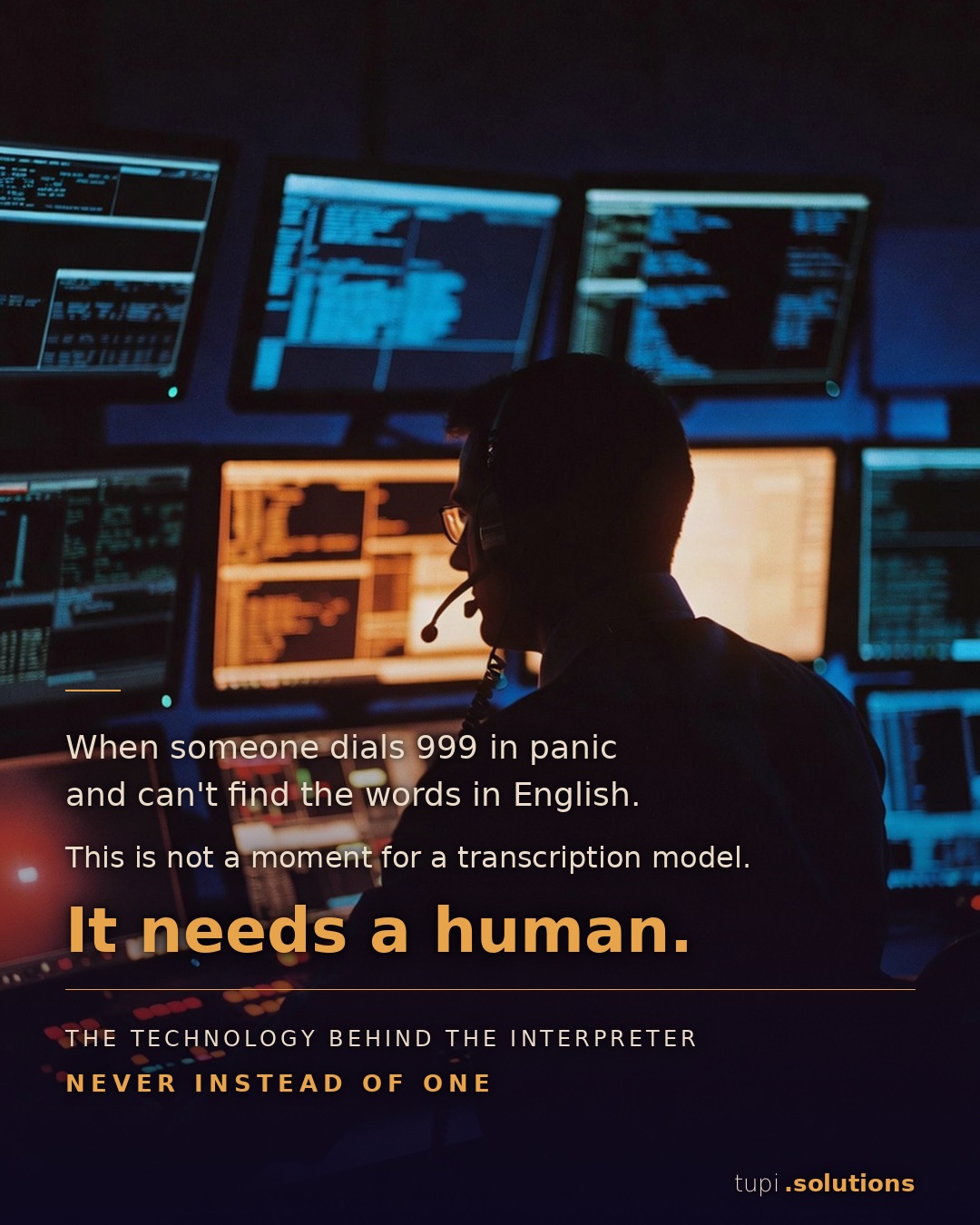
Start with the work itself. "Menial" calls are still someone's livelihood. Scheduling, check-ins, confirmations. This is bread-and-butter volume for interpreters who are already being squeezed on rates. Carving it off and handing it to a machine isn't a neutral efficiency. It is the squeeze. You don't protect a profession by removing the steady, everyday work that keeps people in it and leaving them only the rare, gruelling, high-stakes jobs.
Now look harder at the calls themselves, because "routine" is a fiction. We opened with the patient who has waited months, the cancer-screening booking, the check-in where someone admits they've stopped their medication. And that was the point. None of those are edge cases; they are ordinary Tuesday-morning calls. The fear, the confusion, the disclosure that changes everything: it doesn't wait politely in a separate queue marked "high-risk." It arrives unbidden, mid-sentence, in precisely the conversations a vendor has labelled safe enough to automate.
And that is the flaw no rollover feature can engineer away. AI escalates to a human after it detects difficulty. But by then the emotional moment has already landed, mishandled, on a person who needed it caught the first time. You cannot escalate your way out of a wound that has already been opened. A skilled human interpreter reads the room from the opening breath; software reads it only once it has already gone wrong.
So the whole "low-risk / high-risk" taxonomy is a marketing convenience, not a clinical reality. And notice it only ever moves one way. The same launches that promise to keep "critical conversations human-centered" also boast of expanding to 23 interpreted languages, 253 language pairs, "rarer languages," and "accuracy that surpasses industry standards," alongside a 30% rise in AI-only sessions and case studies headlined "reduced travel costs for human interpreters." The line defining what's "safe for AI" isn't set by the profession. It's set by the vendor, and redrawn outward with every release.
And the pitch underneath all of it never changes: the product "helps them save money." A chief executive can say, in the same breath, that the goal is inclusion and that it "helps them save money." Both may be sincere. But in an industry where interpreters are already underpaid, "save money" has a direction. And it points squarely at the interpreter's invoice. The question is never whether efficiency gets created. It is who keeps it. A fair-pay operator uses it to pay interpreters properly for work only they can do. A profiteering one uses the same tool to pay fewer people less. The technology doesn't decide which. The agency does.
Follow the money: who actually benefits
Be clear-eyed about who is pushing hardest for this. AI doesn't deploy itself into a hospital or a courtroom, an agency chooses to put it there. And the agencies most eager to swap a qualified human for a cheaper machine are too often the same ones that already treat their interpreters as a cost to be minimised: squeezing rates, padding margins, paying late, and pocketing the difference between what the client pays and what the interpreter receives.
For that kind of operator, AI isn't a way to serve clients better. It's the next lever on an interpreter's pay. If you can already justify paying a skilled professional a pittance, a tool that lets you pay nobody at all is simply the logical end point of the same attitude. "The future of interpreting," sold this way, is really the future of the profit margin. And the interpreter is the line item being engineered out.
That is the real story behind the glossy taglines: replacement dressed as innovation, ushered in by businesses profiteering off the very people whose skill they're selling.
What Tupi Solutions does instead
We are a technology company that has made a deliberate choice: we build the technology behind the interpreter, never instead of them.
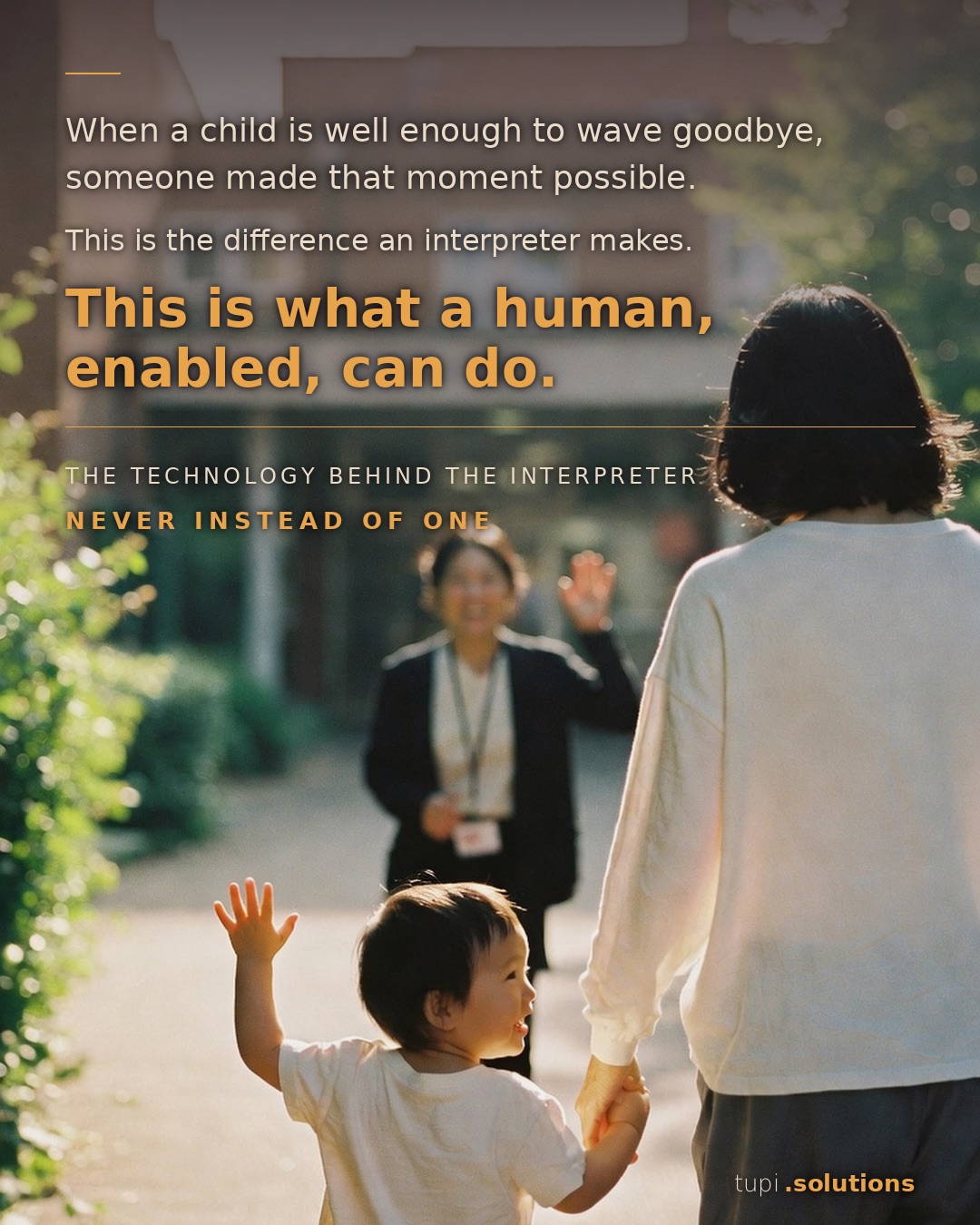
That means our tools take the friction out of an interpreter's working life, scheduling, secure connection, admin, billing. So that the human can do the work only a human can do. It means we only support agencies that pay their interpreters fairly, transparently and on time. And it means we will never put our name to a product whose business case depends on there being fewer interpreters next year than this year.
Let us be precise about this: we are not anti-AI. We are pro-AI, in the right place. Behind the interpreter, never instead of them. Used well, AI can strip out admin, speed up scheduling, and free a skilled professional to concentrate on the work only a human can do. Used as a substitute, it becomes a tool for agencies to profiteer at their interpreters' expense. The technology is the same; the intention is everything. Ours is settled.
We took our name from Tupi, the lingua franca of 16th-century Brazil, the original bridge between languages that made understanding possible between people who could not otherwise communicate. That is exactly what an interpreter does, and it is exactly who we build for. The bridge has always been human. Our job is to hold it up, not hollow it out.
Tupi. Built for interpreters. The technology behind the interpreters, never instead of them.
If you're an interpreter or a fair-pay agency who wants the tech on your side, genuinely behind you, talk to us.
Buying interpreting services? Before you sign, ask the one question the sales deck won't answer for you: what happens when the AI gets it wrong, and who is accountable? If the answer is a disclaimer, you're not buying interpreting. You're buying risk at a discount. Talk to Tupi Solutions first.
The technology behind the interpreters, never instead of them. #BehindTheInterpreter